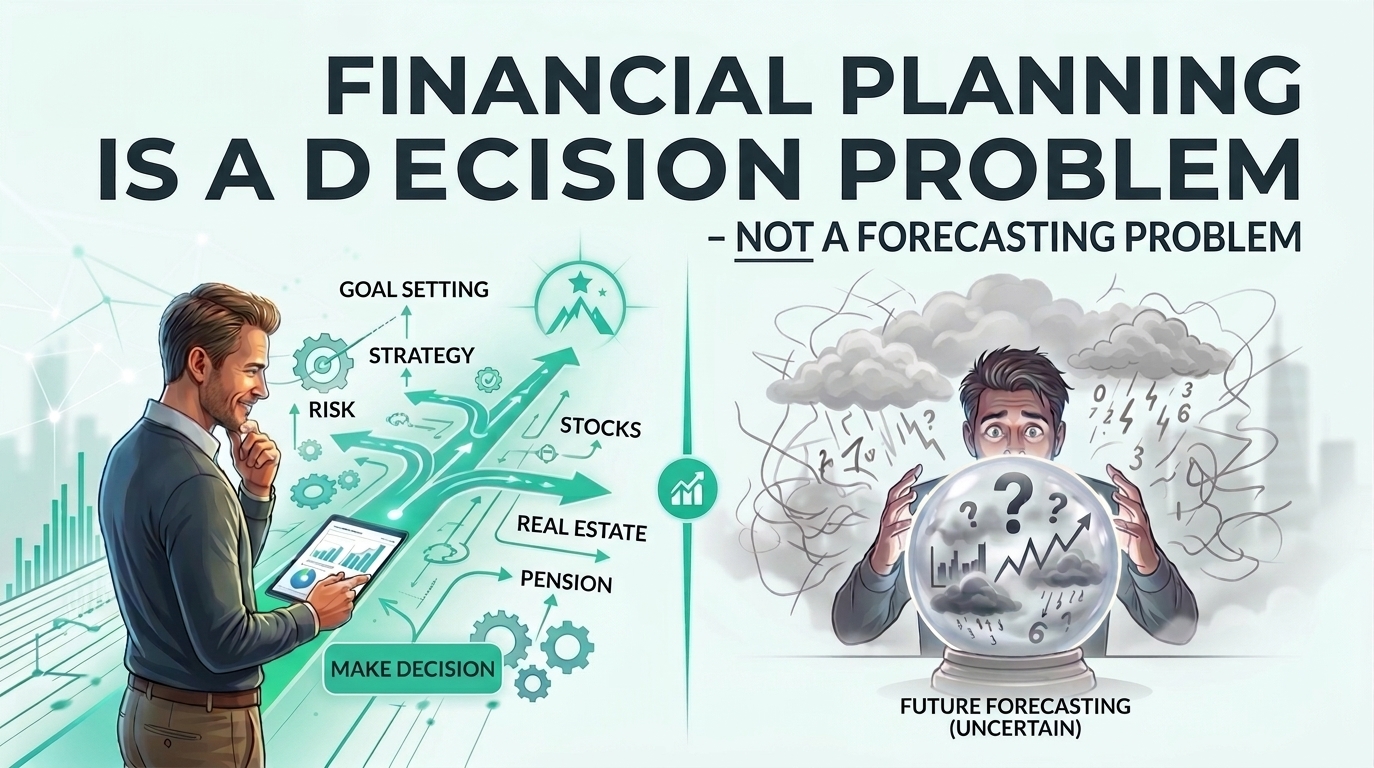
Today, financial planning still begins with a forecast. For example: How high should the expected return be? How will the client's wealth develop accordingly? When can my client retire? How much capital will be available to them in old age? Such questions are important, but they lead to a fundamental limitation that one needs to be aware of. A forecast describes one possible future. What it does not yet tell me is which decisions are right today, tomorrow, and the day after. And this is precisely where the difference between classic financial planning and a dynamic optimization approach lies. Fundamentally, the future cannot be planned like an Excel spreadsheet. Financial life paths do not run in a straight line. Capital markets fluctuate, inflation changes real purchasing power, incomes can rise or fall. Retirement can begin earlier or later, spending changes, life expectancy is uncertain. On top of that, your client's goals change as well. A man who is 45 today is in a completely different financial situation than the same man 20 years later. It is not only his age that has changed, but also his income, wealth, investment horizon, consumption needs, liquidity needs, risk profile, and perhaps his family situation too. The conclusion: a strategy that seems sensible today may later require a different optimal design.
How do we get from a forecast to a decision? A financial advisor calculates for a client a 5% expected return, 2% inflation, a constant savings rate, retirement at 67, and a life expectancy of 92. At the end of the analysis stands a wealth curve. It can be helpful, but it does not answer one crucial question: What should my client do today if the future unfolds differently than assumed? What actually happens if returns turn out lower, inflation higher, if the client wants to retire at 62 instead of 67, if income falls, if they want to consume more, or if they want to transfer wealth to their children already today? The original projection can illustrate these questions, but an illustration is not yet a decision.
The next step in financial planning often consists of scenarios. For example, one might model: Scenario A 5% return, Scenario B 3% return, and Scenario C 1% return. Alternatively, the scenarios could read: Scenario A retirement at 67, Scenario B retirement at 64, or Scenario C retirement at 70. Scenario analyses are already much more helpful. The advisor is able to compare different developments with one another. But here, too, a central task remains with the advisor and the client, namely the question: Which scenario should I choose? Scenario planning shows what could happen; it does not automatically tell you what the best decision is given the goals and preferences at hand.
Modern financial planning can therefore go one step further and develop a different understanding of what financial planning is. Instead of asking only what will happen, the real question is: Which decisions best support the client's goals across the range of possible future developments? That, however, is an entirely different mathematical problem. It is about decisions under uncertainty. And this is exactly where stochastic optimization and stochastic control become relevant. But what does that mean for financial advice? A client does not have just a portfolio, but an entire financial life. This includes, among other things, income, saving, investing, retirement, withdrawals and consumption, as well as wealth transfer. All of these individual decisions are interconnected. Whoever consumes more today may have less wealth later and may not be able to close the pension gap. Whoever saves more today can consume more later and enjoy a worry-free retirement. Whoever relies more heavily on liquidity holds more short-term available capital, but may invest less over the long term. Whoever wants to leave a larger inheritance may have to plan their own consumption differently. In this way — and this is very important to understand — financial planning becomes a system of interconnected decisions.
Asset allocation is therefore not an isolated decision. As we saw earlier, asset allocation is traditionally treated as a separate portfolio question: How much in equities and how much in bonds should the client hold? In the life-cycle context, we ask a broader question: Which asset allocation supports the client's financial goals over their entire life cycle, when we account not only for decisions today but also tomorrow and the day after? The answer to this question depends not only on risk tolerance, but is also influenced by factors such as age, income, existing wealth, future cash flows, investment horizon, consumption needs, liquidity preference, retirement date, and desired legacy. The optimal asset allocation changes as the client's circumstances change. Beyond the classic assets, a comprehensive life-cycle analysis should also make use of insurance products such as a life annuity, in order to stabilize consumption and minimize longevity risk.
Let us now look at what stochastic control changes here. Stochastic control theory does not view a financial decision as a one-off, but as a dynamic process that extends into the future. In simplified terms, the problem consists of four components. First, the current state: What does the financial situation look like today? Second, the uncertain future development: How might markets, inflation, income, or lifespan evolve? Third, the decisions: How much is saved, invested, and consumed today, tomorrow, and the day after? And finally, the objective: How can the client's preferences be met as well as possible over the life cycle? In this way, one does not merely calculate a single possible future path, but searches for a strategy governing today's decision and all subsequent ones.
We move from a single number to a chain of decision rules. That is a decisive difference. A static financial plan might say, for instance: The equity ratio is 60% today. A dynamic strategy, by contrast, asks: Which asset allocation makes sense given the current financial state — and how should it change as the overall state changes? In this way, a single recommendation becomes a chain of decision rules. If, for example, wealth, income, retirement date, consumption needs, or market conditions change — what effect does that have on my optimal decisions, and how should we invest, consume, and insure?
And this is exactly where LifeOptima comes in. LifeOptima was built with precisely this perspective in mind: not only to show what could happen, but to calculate which financial decisions, in their temporal sequence, are sensible given the goals and constraints at hand. The LifeOptima platform describes its approach as a shift from projection to optimization. In traditional financial planning, there are inputs, assumptions, a projection, and from that the results. In scenario planning, the inputs come first, then the various scenarios, then the comparison, and from that the derived result. With LifeOptima, by contrast, the goals come first, then the financial situation, then real-time optimization, the recommended strategy — and only then do the advisor and the client jointly reach a decision. This is not just a different workflow; it is a different understanding of what financial planning is meant to accomplish.
And above all, the advisor remains the decision-maker. One point is especially important here: LifeOptima does not replace the financial advisor. The technology only takes over the complex calculation. The advisor still has to understand the goals, set the priorities, weigh the preferences, evaluate trade-offs, assess recommendations, and, in the end, reach a decision together with the client. In doing so, questions like these are addressed: If I give away more today, how does that change my future consumption? Or: If I want more security, how does that change my optimal investment strategy? Such questions are genuinely relevant, and LifeOptima provides a mathematically optimized starting point for them and visualizes the relevant trade-offs. The mathematics does not have to be visible in the client conversation; the visualization and its impact, however, do. The mathematics behind it simply ensures that you are not relying solely on gut feeling, rules of thumb, or a single forecast. The role of the financial advisor changes — not away from advising, but away from manual calculation. Their task is to understand, to interpret, to explain, and to decide. The technology calculates, optimizes, simulates, and visualizes. This allows financial advice to focus more fully on supporting people through complex financial decisions.
The future cannot be predicted exactly. But financial decisions can be made more systematically. And so the core idea of LifeOptima is this: classic financial planning forecasts, scenario planning compares, LifeOptima optimizes. The future is uncertain. Your strategy, therefore, should not remain static, but should become dynamic.